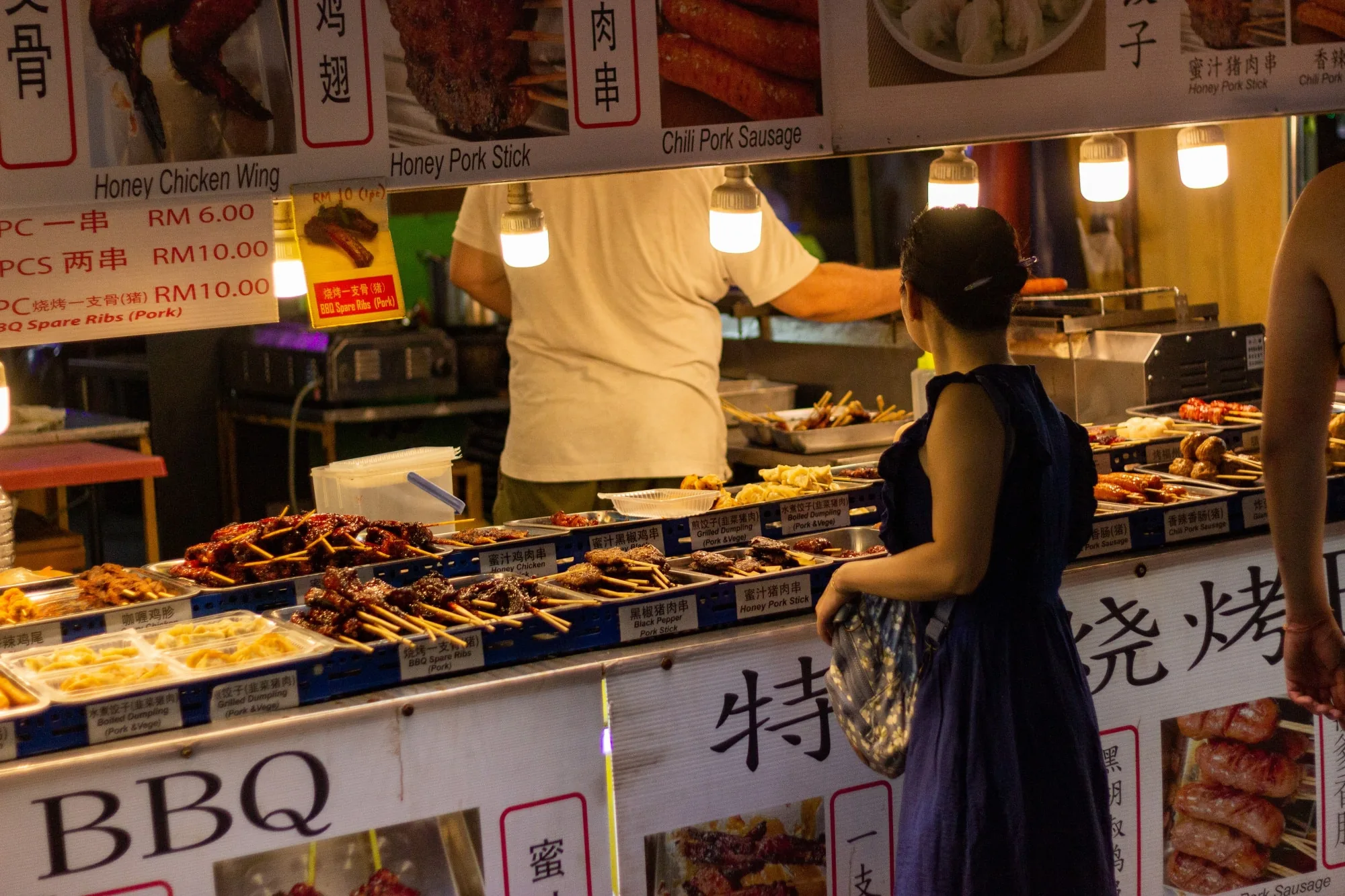
Two ways to eat in Osaka
Going it alone
vs. having a guide
Both work. One of them tends to leave you with better stories and a clearer understanding of what you actually ate.
Back to homeWhy the comparison matters
Osaka is genuinely one of the easiest cities in the world to eat well without any help. Walk into any alley and something good will find you. We want to be honest about that.
What a guide changes is not the quality of the food — the street stalls are exactly the same stalls. What changes is how much of what's happening you actually catch. The context, the ordering customs, the reason a particular broth tastes the way it does, the fact that the cook behind the counter has been doing this since before you were born.
That context is what we think is worth comparing.
Side by side
Eating through Osaka on your own
-
Complete freedom
You walk where you like, stop when you want, and there is nobody to keep pace with. The city is yours at whatever speed suits you.
-
Language and ordering gaps
Menus are often picture-only or handwritten in Japanese. Pointing works, but the conversation about what you're eating rarely happens.
-
Accidental discoveries
Sometimes you stumble onto something remarkable. Other times you queue for twenty minutes at a place that turned out to be famous for the wrong reasons.
-
Memory without story
The flavours stay with you. The detail of what made them that way is usually gone by morning.
An evening or morning with Shadow Strand Bridge
-
Curated without being controlled
A guide selects the stops, handles the ordering, and explains what's coming — but the pace is set by you, not a clipboard. There's always room to linger.
-
The language barrier disappears
Conversations that would normally be impossible become straightforward. Cooks who rarely speak to visitors sometimes open up when the right introduction happens.
-
Deliberate discovery
The stops are chosen because there is something worth knowing about each one. Not because they have the longest queue or the biggest sign.
-
Flavour with a story attached
You leave knowing what you tasted, why it tasted that way, and a little about the person who made it. That part tends to stick.
What we do differently
Groups are kept small
Sessions are designed for small numbers so the experience stays personal. The guide can actually talk to everyone and nobody gets lost at the back of a crowd.
We know the vendors personally
The stalls we visit are not sourced from a list. They are places where the person behind the counter already knows us. That makes the whole thing feel less like tourism.
The pace is decided by the group
No fixed clock on each stop. If someone wants to ask more questions or simply sit with a bowl a little longer, we sit a little longer. That's the whole point.
What the difference actually looks like
Measured not in stars or ratings, but in what most people say they remember afterwards.
Understanding what you ordered
On your own
You recognise takoyaki from photos. Beyond that, the finer details of seasoning, batter thickness, and the significance of the sauce tend to pass without notice.
With a guide
You hear what distinguishes one style from another, why this particular stall does it the way it does, and what to look for when you try it somewhere else.
The social experience at the counter
On your own
A polite nod from the cook and a brief wait. The interaction is transactional and warm in the way all good Osaka service is, but it doesn't go further.
With a guide
An introduction changes things. Cooks who have known our guides for years will occasionally take a moment to explain something, or simply acknowledge the visit in a way that feels genuine.
What you take home from the experience
On your own
Photographs, a satisfied feeling, and a rough memory of which streets you wandered down. Possibly a name on your phone you can't quite place anymore.
With a guide
A mental map of what you tasted and why. The name of the broth style that suited you most. A few things you can actually look for or attempt when you get home.
The honest cost picture
Eating alone in Osaka is inexpensive. A guided session costs more. Here's what that difference actually pays for.
Going it alone — what you spend
- ·Food costs at street stalls — modest, averaging ¥400–800 per item
- ·Occasional wrong queue — time spent, money spent, sometimes both
- ·No overhead — you pay for exactly what you eat
- ·A full evening of wandering might run ¥2,000–3,500 total
A session with Shadow Strand Bridge — what you get
- ·All food and tasting portions included in the session price
- ·A guide's decade-plus of accumulated knowledge, distilled into one evening
- ·Direct introductions to cooks and vendors we have known for years
- ·Sessions from ¥4,400 — comparable to a single mid-range restaurant meal
The gap between the two is not as large as it might seem when the food is included. The difference is really in what else you leave with.
What the evening feels like
Navigating alone
You arrive in Dotonbori or Shinsekai, consult your phone, and pick a direction. The alleys are genuinely wonderful even without any preparation. You eat well. You photograph things. You may feel occasionally uncertain about etiquette or whether you are in the right place.
The experience is real and it is yours. It can also be slightly solitary, particularly if you don't speak any Japanese and the stall is busy with regulars.
An evening with us
We meet you at an agreed spot in the alley. From the first stop, there is someone to explain what's being prepared, why it smells the way it does, and what the small customs of this particular counter are. Questions are welcomed.
The pace moves with the group. Nobody rushes you through a skewer. The evening ends when it feels right to end, not when a timer runs out.
What stays with you
Eating in Osaka for three days on your own gives you a collection of tastes and a vague sense that you have barely scratched the surface. That feeling is correct — the surface is enormous.
A few hours spent learning the logic behind the food — why broth is made the way it is, what distinguishes regional ramen styles, how street snacks evolved from practical cooking into something people travel across Japan for — tends to change how you approach the rest of your time here.
It also tends to follow you home. People who understand a little about what they ate find themselves seeking out good Japanese restaurants with more confidence, cooking things from memory, and occasionally boring their friends with very specific opinions about dashi.
A few things worth clarifying
Not just a tour
A walking food tour typically moves a group from restaurant to restaurant on a fixed route. What we do is closer to eating with someone who grew up in the neighbourhood and happens to know everyone.
Not a replacement for exploring alone
We are not suggesting you should never wander Dotonbori without a guide. Many people spend an evening with us and then head back on their own the following night with fresh eyes. That's a perfectly good outcome.
Not for beginners only
People who already know Japanese food well sometimes find the broth sitting or kitchen session more rewarding than a first-time visitor would. The depth is there if you want it.
Not a set script
Each session adapts to whoever is there. Two groups going through the same evening experience will have noticeably different conversations, because different people ask different things.
Why people tend to choose a guided experience
They have a limited number of evenings in Osaka and want to make sure at least one of them is genuinely understood, not just photographed.
They are already interested in Japanese food and want to go a level deeper than what a menu or a travel article can offer.
They are travelling with people who have different appetites or comfort levels, and want an evening that works for everyone without anyone having to manage it.
They want the kitchen session specifically — to actually make something, take the knowledge home, and try it again on a Tuesday in their own kitchen.
A seat is open if you want it
You can read about the difference all evening. The more useful thing is to come and see it for yourself. Send us a note and we'll find a time that works.
Get in touch